Jacob is one of those Bible characters I really don’t want to identify with.
And yet, somehow, there are similarities.
There were earlier seasons of my life when, like Jacob, I was much too busy being Allan-Matthew. Trying to figure myself out. Trying to establish myself. Trying to become somebody. Trying to make the right decisions, open the right doors, prove myself capable, secure the future, and somehow make sure my life became what I thought it was supposed to become.
Not necessarily in some wildly sinful or rebellious way. Sometimes striving can look remarkably responsible.
You’re working. Planning. Building. Studying. Dreaming. Trying to become financially stable. Trying to figure out your calling. Trying to become mature. Trying to build a life.
But underneath all of that activity can be a quiet anxiety: Will my life work out?
One of my favourite books is Sacred Fire by Ronald Rolheiser. For about four years, I read it almost every year. Rolheiser describes Christian maturity through stages, beginning with what he calls the struggle to get your life together.
It’s that season, often associated with youth and early adulthood, when so much of our energy goes toward establishing ourselves. We’re developing convictions, building a moral foundation, discovering who we are, finding stability, developing our faith, and trying to make something meaningful of our lives.
And when I come to Genesis 27, I wonder if Jacob is somewhere in that territory too. Although, depending on how you work out the chronology, Jacob may have been around 77 years old.
So apparently you can still be trying to “get your life together” long after your knees have started giving trouble.
Jacob’s version of getting his life together might better be called striving for blessing.
Genesis 27 is filled with self-effort, self-interest, and self-preservation.
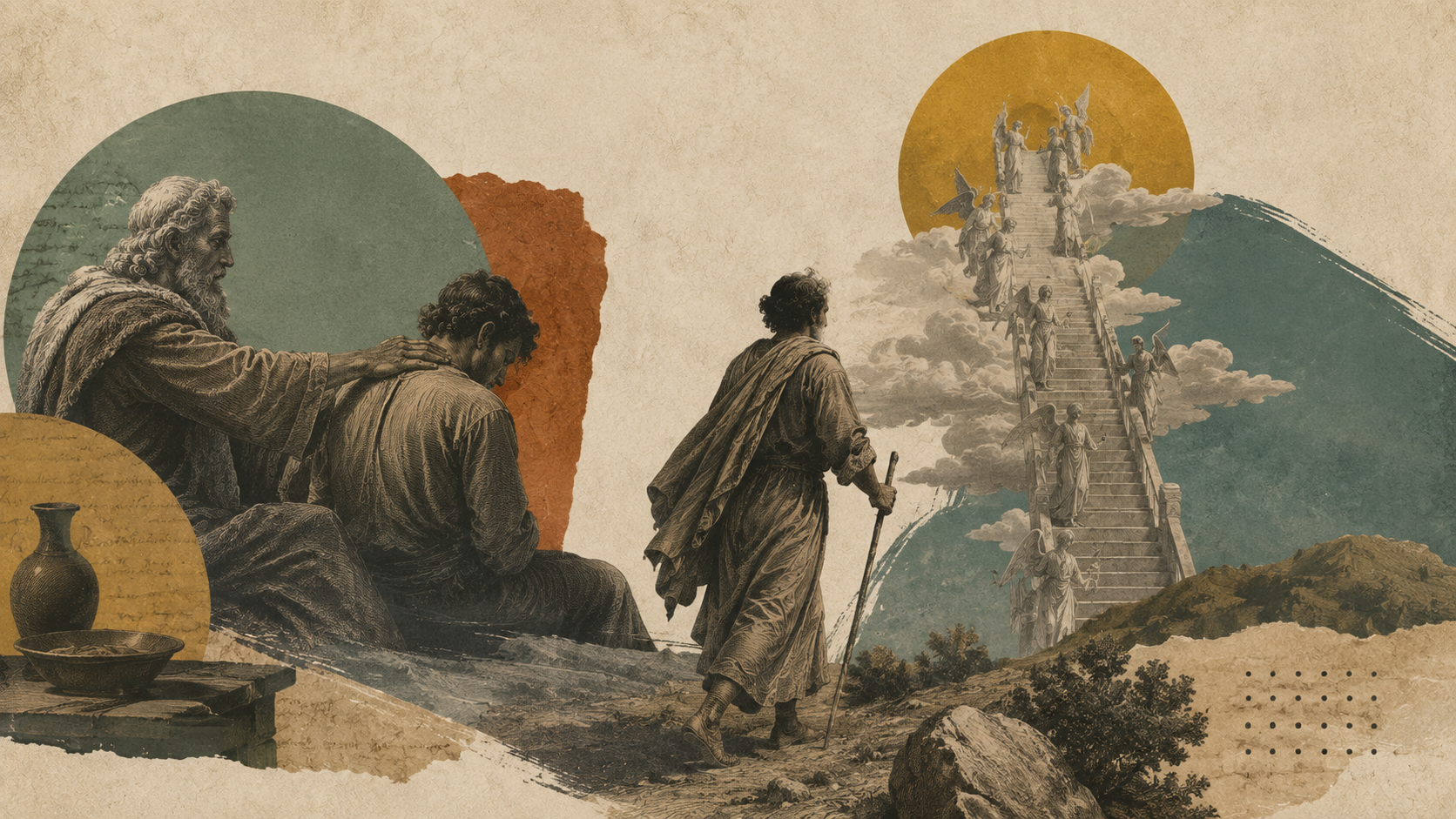
Isaac intends to bless Esau. Rebekah overhears the conversation and develops a plan. Jacob dresses in his brother’s clothes, covers his arms with goat skin, brings his father food, lies about his identity, and receives the blessing intended for Esau.
It is messy.
But what makes the story even more striking is that Jacob was striving to secure something God had already spoken over his life.
Before Jacob and Esau were even born, God told Rebekah, “the older shall serve the younger” (Genesis 25:23).
God had already spoken.
Jacob did not need to manipulate his way into God’s purpose. Yet he did. And I understand him more than I would like to admit. Because sometimes our greatest striving happens around things God has already invited us to trust Him with.
We know God is our provider, but we manipulate. We know God directs our steps, but we panic. We know God has given us gifts, but we compare. We know our identity is found in Him, but we keep trying to prove ourselves. We know His timing is good, but we start grabbing.
Jacob’s name itself is connected with grasping. He entered the world holding his brother’s heel, and much of his early story feels like a man constantly reaching for something.
The birthright.
The blessing.
The future.
Security.
Jacob keeps grasping. And eventually his grasping works. Sort of.
He gets the blessing, but loses his home. He secures what he wanted, but has to run for his life.
By Genesis 28, Jacob is leaving everything familiar behind. He is travelling toward Haran, away from his parents, away from Esau, away from the life he knew.
Then night comes.
Jacob stops, takes a stone, places it beneath his head, and falls asleep. It is an ordinary stone to rest his head, but ordinary things can become places of encounter.
That is part of what I explore in Stones & Soil: Where Faith Finds Its Way: faith is often formed in the unremarkable places we would rather pass through quickly—the hard ground, the uncertain seasons, the nights when we have no clear sense of what God is doing.
Jacob does not meet God in a sanctuary or at the end of a successful journey. He meets Him with his head resting on a stone, while he is running from the consequences of his own choices.
The stone does not make the night comfortable. But it becomes a witness that God was present there.
Sometimes faith finds its way through stones like that. Not by removing every difficulty, but by teaching us to recognize God’s presence in the middle of it.
Jacob dreams of a stairway stretching between earth and heaven, with the angels of God ascending and descending upon it. And above it stands the Lord.
What amazes me is what God does not say. God does not begin with, “Jacob, explain yourself.” He does not say, “Before we discuss your future, we need to talk about what happened back there.”
God gives Jacob a promise. “I am the LORD, the God of Abraham your father and the God of Isaac.” Then God promises him land, descendants, purpose, presence, protection, and eventually a return home.
And here is the line that gets me: “Behold, I am with you and will keep you wherever you go” (Genesis 28:15).
Jacob had spent Genesis 27 trying to secure a blessing through his own effort. In Genesis 28, God simply gives Himself. That changes everything.
Jacob thought blessing was something he had to grab. God was teaching him that blessing begins with presence.
“I am with you.”
Maybe that is part of the movement of Christian maturity.
There is a season when so much of life is about getting your life together. Establishing yourself. Finding your place. Discovering your gifts. Building something. Becoming someone.
And none of that is necessarily wrong. But eventually God begins loosening our grip. Because discipleship cannot remain centred on building our lives. At some point the question changes from: How do I make something of my life? to: God, what would You like to do with the life You have given me?
Jacob still has a long journey ahead of him after Bethel. There is Laban. There are wives and children and conflict and wealth. There is another night many years later when Jacob will wrestle with God until morning.
The striver does not disappear overnight. Neither does ours.
But Bethel becomes a turning point because Jacob encounters a God who cannot be manipulated, earned, controlled, or outsmarted.
But a God who graciously meets him while he is running from the consequences of his own decisions. A God who says, in effect: Jacob, your future does not ultimately depend upon how tightly you can hold onto it.
And maybe somebody else needs to hear that. Maybe you have spent years striving for blessing. Striving to become enough. Striving to secure your future. Striving to establish your name. Striving to make everything work. Striving to hold together the life you have carefully built.
There comes a point when God invites us to unclench our fists.
Because the Christian life is not ultimately the story of how successfully we grabbed hold of God’s blessing.
It is the story of God’s generosity. Of a God who comes to strivers while they sleep on stones. A God who finds us in places we never planned to be. A God who speaks promises over people who are still very much works in progress.
Jacob was busy trying to get his life together. But God was already at work putting Jacob together.
And looking back, I think He has been doing the same with me. And yeah, you too.
He’s the One we Proclaim
A.M.