There are seasons in life when it feels like something has stalled.
A prayer has gone unanswered. A dream has been buried. A door has closed. A relationship has changed. A situation that once carried hope now feels final. You thought by now something would have shifted, something would have opened, something would have made sense. But instead, you are left waiting.
And in the waiting, the questions come quietly.
“Lord, where are You?”
“Why haven’t You come yet?”
“Why hasn’t this changed?”
“Why does it feel like You are taking so long?”
That tension between faith and waiting is not new. It sits at the heart of one of the most powerful stories in Scripture: the raising of Lazarus in John 11.
Lazarus was sick. His sisters, Mary and Martha, sent word to Jesus: “Lord, he whom you love is ill” (John 11:3). Their message was simple. They were not appealing to Lazarus’ goodness, his service, or his worthiness. They were appealing to Jesus’ love.
And that is what makes the story difficult.
John makes it clear that Jesus loved Martha, Mary, and Lazarus. Yet when Jesus heard that Lazarus was sick, He stayed where He was for two more days.
Jesus loved them.
And Jesus waited.
That feels strange to us because we often assume love should always move quickly. If Jesus loves, surely He should come immediately. If Jesus cares, surely He should fix it now. If Jesus is able, surely He should act before the situation gets worse.
But John 11 confronts us with a hard but necessary truth: God’s delay is not the same as God’s absence.
By the time Jesus arrives, Lazarus has already died. Not only that, he has been in the tomb for four days. From every human angle, the moment for healing has passed. The funeral has happened. The grief has settled in. The situation is no longer sick; it is dead.
Martha meets Jesus with words many of us have felt, even if we were too afraid to say them out loud: “Lord, if you had been here, my brother would not have died” (John 11:21).
That sentence carries both faith and pain.
Martha still believes Jesus has power. But she is also disappointed. She knows what Jesus could have done, and she is grieving what did not happen.
Mary says the same thing later: “Lord, if you had been here, my brother would not have died” (John 11:32).
Both sisters bring their pain directly to Jesus.
That matters.
They do not pretend everything is fine. They do not hide behind religious language. They do not act as though grief is somehow unspiritual. They bring their honest disappointment to the Lord.
And Jesus does not rebuke them for it.
Instead, He enters their sorrow.
John tells us, “Jesus wept” (John 11:35).
That verse is short, but it is not small.
Jesus knew Lazarus would soon walk out of the tomb. He knew resurrection was coming. He knew the story was not over. Yet He still wept.
This tells us something deeply comforting about the heart of Christ. Jesus is not emotionally distant from human suffering. He does not treat our pain as insignificant just because He knows the ending. He does not rush past grief simply because He holds resurrection power.
He meets people in their sorrow.
Faith does not mean pretending pain does not hurt. Faith means bringing the pain to Jesus.
That is one of the great invitations of John 11. Bring Him your confusion. Bring Him your disappointment. Bring Him the prayers that did not get answered the way you hoped. Bring Him the thing that feels buried. Bring Him the place where you feel like saying, “Lord, if You had been here…”
Jesus can handle honest prayers.
But the story does not end with tears.
Standing near the tomb, Jesus speaks one of the most important declarations in the Gospel of John: “I am the resurrection and the life” (John 11:25).
Notice what He does not say.
He does not merely say, “I can perform resurrection.”
He does not merely say, “I believe in resurrection.”
He says, “I am the resurrection and the life.”
Resurrection is not just an event Jesus can produce. Resurrection is who He is. Life is not merely something He gives. Life is found in Him.
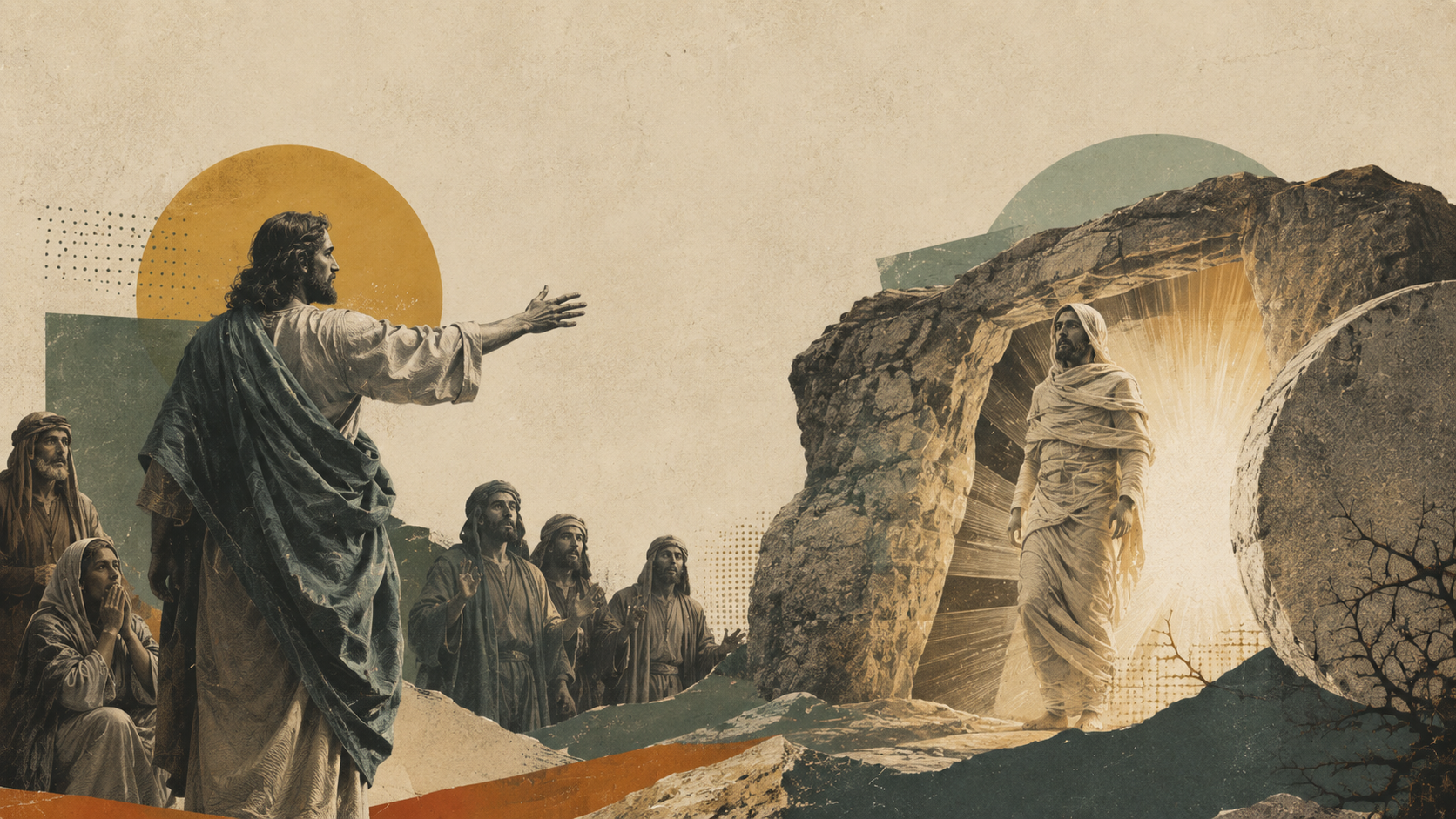
Then Jesus stands before the tomb and calls Lazarus by name.
“Lazarus, come out.”
And the dead man walks out alive.
That moment proves that what looked final was not final. What looked buried was not beyond Jesus. What looked like the end became the place where His glory was revealed.
This does not mean every situation in our lives will be restored exactly the way we want. John 11 is not a blank cheque for every dream, every relationship, every opportunity, or every desire to come back in the form we imagined.
But it does mean this: death does not get the final word when Jesus is present.
Brokenness does not get the final word.
Delay does not get the final word.
Disappointment does not get the final word.
The tomb does not get the final word.
Jesus does.
The raising of Lazarus points us beyond Lazarus. A few chapters later, Jesus Himself would go to a tomb. He would be arrested, crucified, buried, and for three days it would look like death had won.
But on the third day, Jesus rose.
And when Jesus walked out of His own tomb, He proved forever that His words to Martha were true.
“I am the resurrection and the life.”
That is the hope at the center of the Christian faith. Sin leaves us spiritually dead and separated from God. No amount of effort, morality, or religious activity can fix that. But Jesus came, took our sin upon Himself at the cross, died in our place, and rose again so that all who trust in Him can receive forgiveness and new life.
So when you are waiting, trust Him.
When you are hurting, bring the pain to Him.
When something feels dead, remember who He is.
Jesus may not always come when we expect. He may not always act in the way we imagined. But His delay is never defeat. His silence is never indifference. His timing is never careless.
The one who called Lazarus out of the tomb is still the resurrection and the life.
And because of Him, dead ends don’t win.